.png)
.png)

.png)
.png)


.png)




 Insights
 Science
 Compliance
 Laura de Querol
UV Medico & Falck: Elevating Ambulance Safety with UV222 Technology
 Mads Emil Bandholm : 14 May, 2024
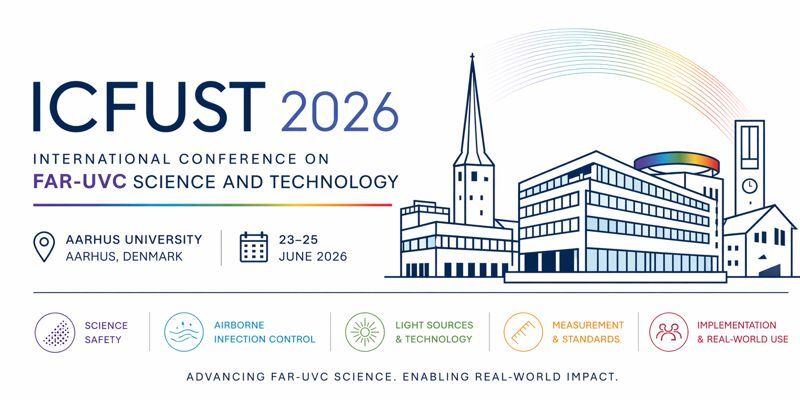
For three days in June, the global Far-UVC community came together in Aarhus. The conference framed the moment as a turning point for the technology: the point at which Far-UVC starts moving out of the research lab and into the everyday, occupied spaces where people live and work.
Researchers, clinicians, engineers, public health experts, and manufacturers gathered for the International Conference on Far-UVC Science and Technology (ICFUST 2026), hosted by Aarhus University with an international scientific committee.
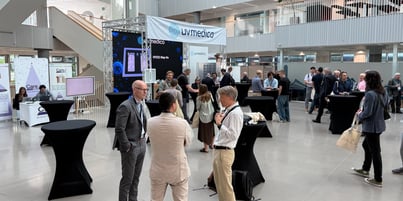
Far-UVC research conference exhibition, ICFUST 2026.
Dr. Manuela Buonanno of the Center for Radiological Research at Columbia University opened the conference. As part of the team whose early work helped establish the field, she was well placed to lay out where the science stands today and where it is heading. Her message carried through the next three days: Far-UVC is steadily moving beyond the laboratory, and most of the work now is figuring out how to use it safely and effectively in the places people are present.
One thread ran through many of the talks: alongside years of laboratory research, a growing share of the evidence now comes from real settings — clinics, care homes, and occupied buildings rather than test chambers.
Professor Edward Nardell of Harvard Medical School shared preliminary findings from an ongoing controlled study at a dedicated airborne-infection research facility in South Africa. Rather than relying on artificial aerosols, the study draws air directly from the rooms of tuberculosis patients to measure real, human-generated transmission. In the data presented so far, Far-UVC was associated with a reduction in TB transmission of around 91%. Tuberculosis remains one of the world's leading infectious killers.
Professor Christian Holm of Aarhus University presented findings from a six-month controlled trial across 12 Danish long-term care facilities, published in Antimicrobial Stewardship & Healthcare Epidemiology. In facilities fitted with Far-UVC, residents had markedly fewer infections requiring hospital treatment and fewer antibiotic prescriptions than those under usual care. This was an early-stage, non-randomized study (a phase II trial), designed to test the approach in practice and set the stage for a larger randomized trial to follow. See the published results here.
These were two contributions among many. Research groups from Europe, North America, Asia, and the Middle East presented their own studies on how well Far-UVC works and how safely it can be used, adding to a body of evidence built up over years of research into infection prevention and pandemic readiness.
Much of the conference's energy went into application. Sessions covered airborne infection control, photobiological safety, indoor air chemistry, clinical use, governance, and standards — the practical details that decide how a technology reaches everyday use. At the same time, the conversation was as much about open questions as settled ones — effectiveness, exposure, measurement, and implementation were all actively discussed and debated. Working through these together, across disciplines, is how a maturing field turns evidence into everyday practice.
Among the talks on real-world application, Professor Jameela Al-Salman brought a different vantage point.
As Chair of the WHO Strategic Technical Advisory Group on antimicrobial resistance and a consultant physician in infectious diseases, she spoke from the clinical front line — where decisions about adopting new technology are actually made. She traced the path from innovation to implementation: infectious threats are rising, much of the harm they cause is preventable, and healthcare needs tools it can put to work in live environments. Far-UVC, she noted, can keep disinfecting air and surfaces while patients and staff go about their day, with no downtime and no disruption to clinical routines.
Her framing stayed with many in the room: Far-UVC is "not a replacement for infection prevention — it is a force multiplier." One more layer of protection for patients, and part of being ready for whatever comes next.
At UV Medico, we believe in making a difference by fusing science, engineering, and passion, and we were proud to take part in ICFUST 2026 as a sponsor of the event.
The three days in Aarhus meant so much to us. The conference brought together people from labs, hospitals, and industries, all driven by the same goal: cleaner, safer air in the places where people live, heal, learn, and gather.
Far-UVC is making its way from the laboratory into the real world, and we want to help carry it there carefully and credibly, so its protection reaches the people who need it most.
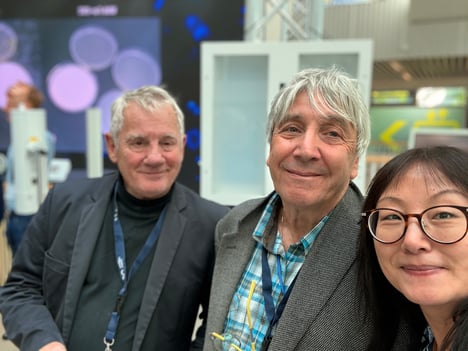
Peter Johansen (Co-founder & CTO, UV Medico), David Brenner ( David J. Brenner, PhD, DSc, Columbia University), Ping Hu (Communications Director, UV Medico)

%20(1).jpg)


.jpg?width=30&name=Untitled%20design%20(26).jpg)
.jpg)