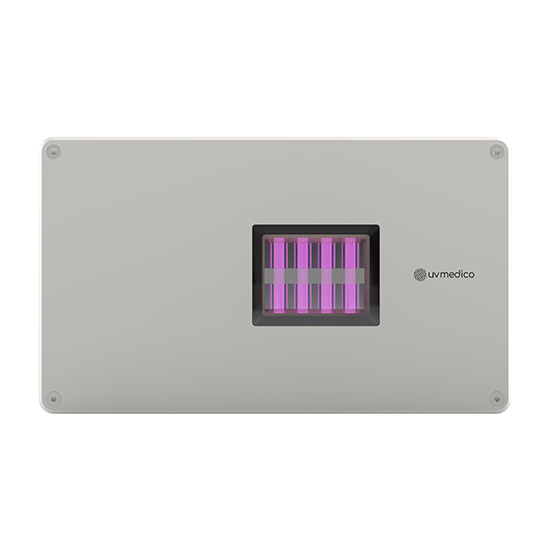
Far-UVC Compliance and Certifications
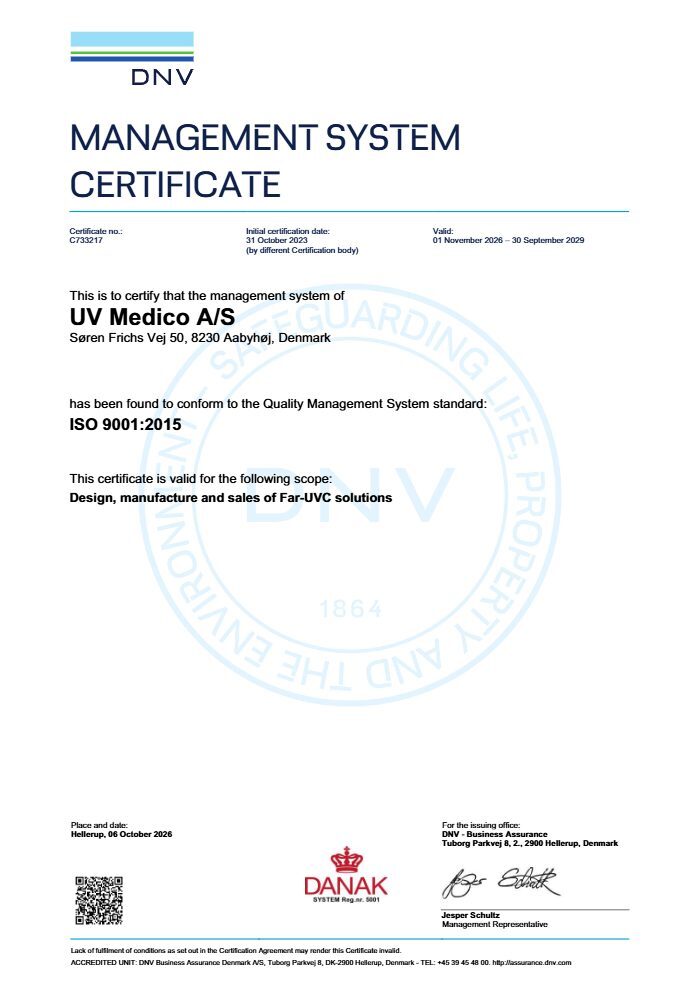
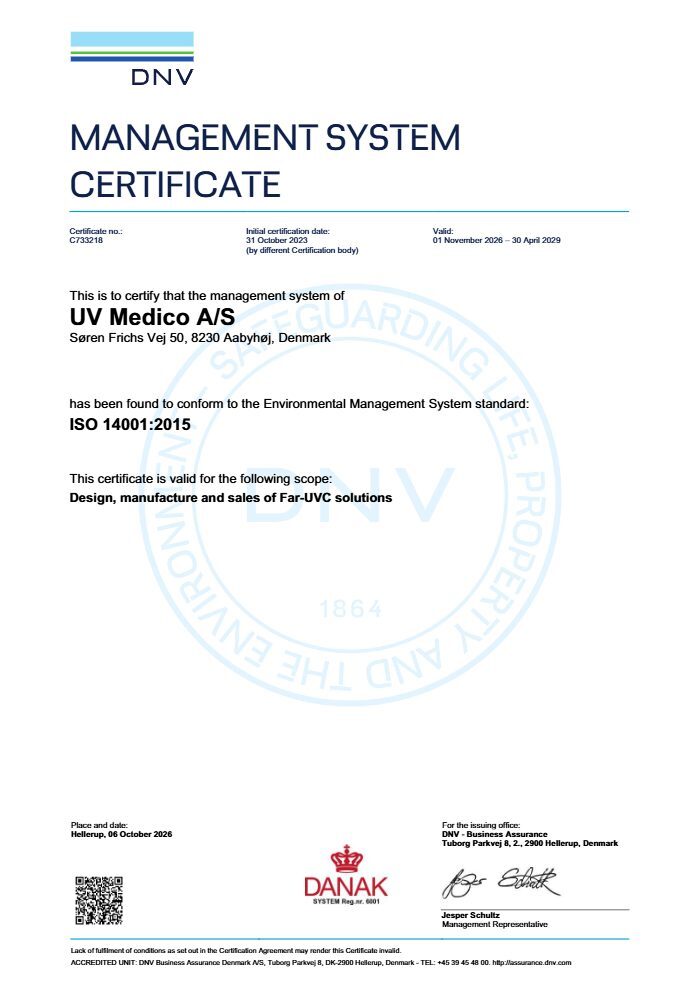
UV Medico A/S manufactures UV222™ filtered 222 nm Far-UVC systems under three certified management systems: ISO 13485, ISO 9001 and ISO 14001.
UV222™ products are CE marked and operate within ACGIH / ICNIRP exposure limits.
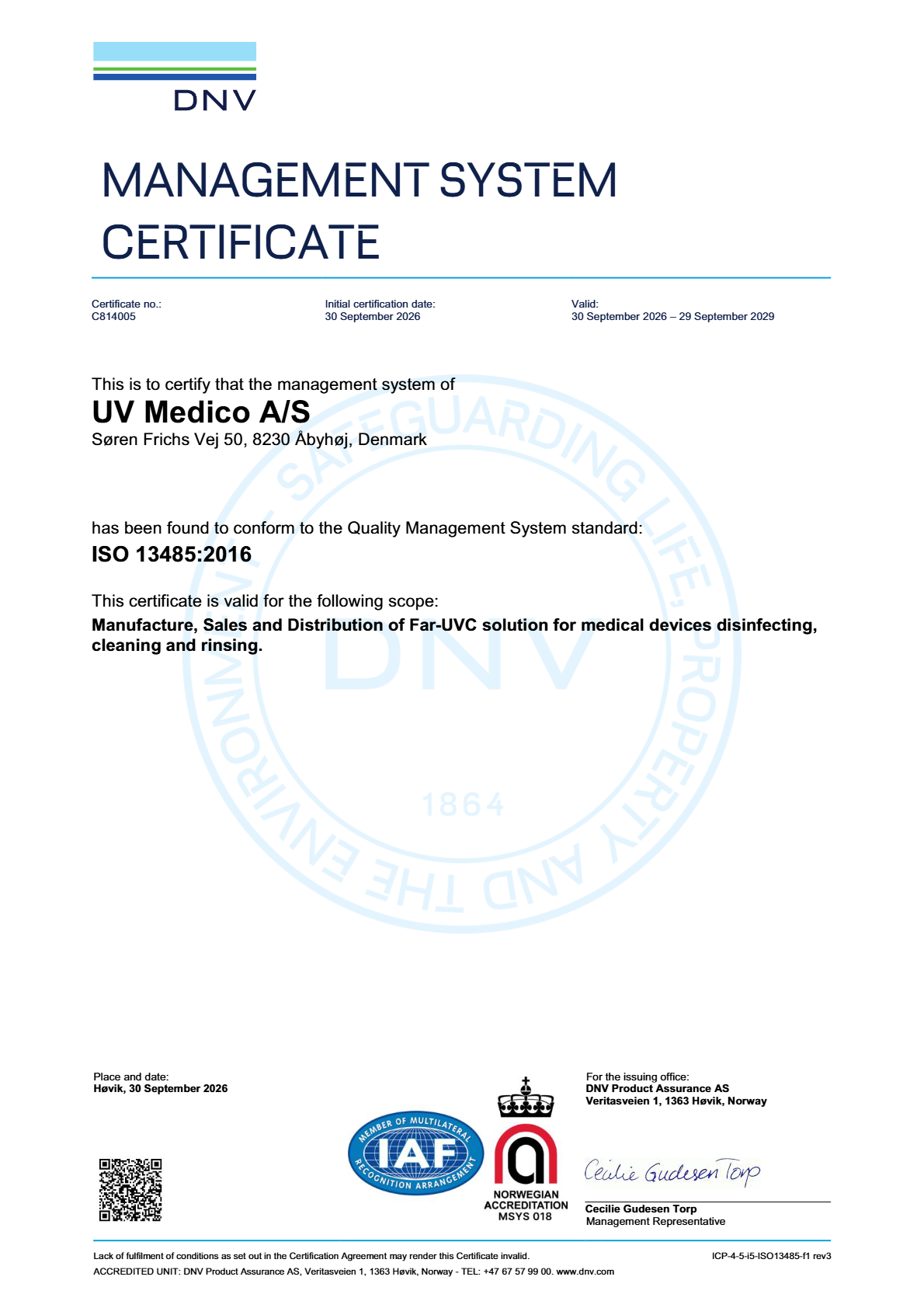
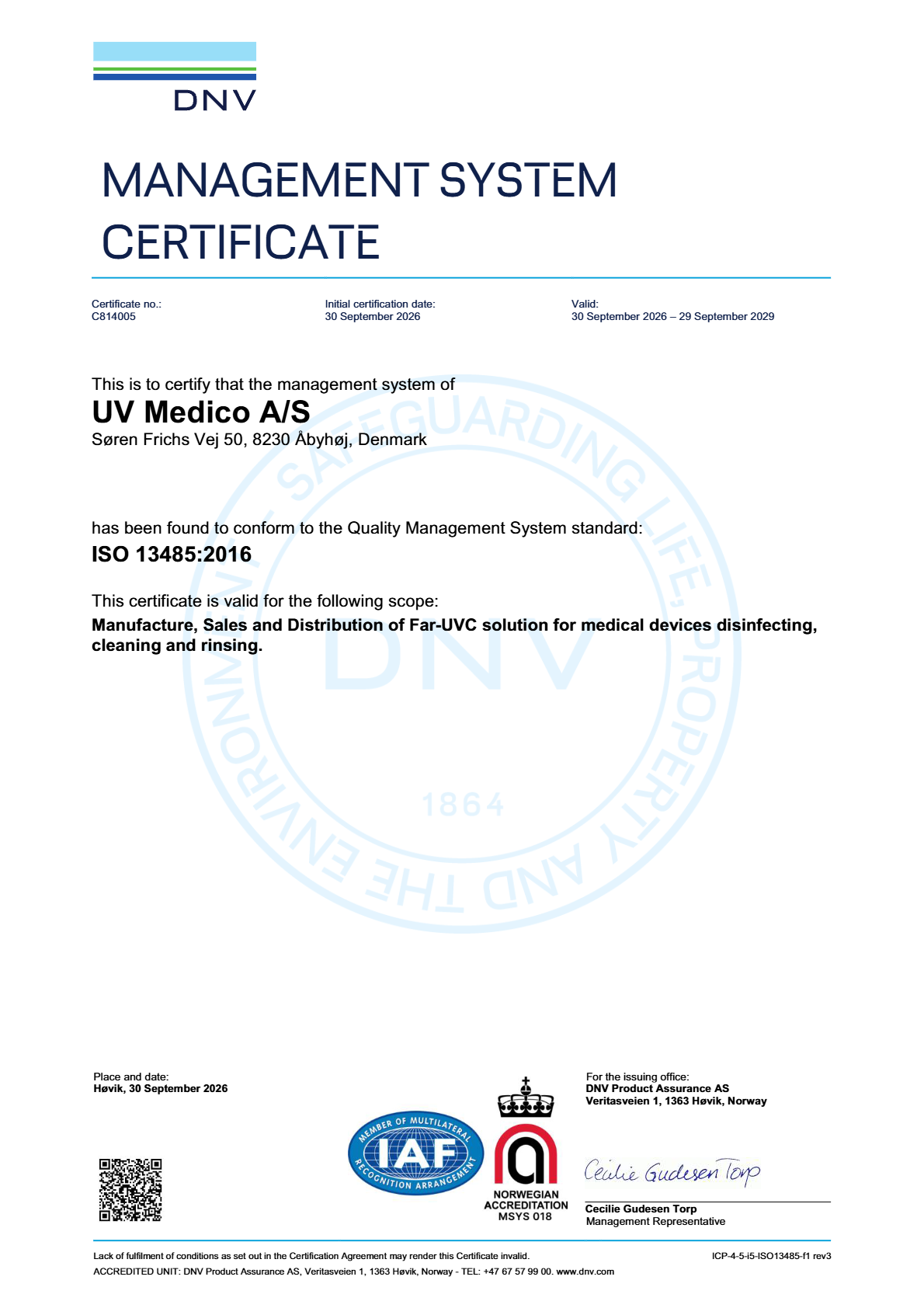
ISO 13485:2016 · Certified by DNV
UV Medico is an ISO 13485-certified manufacturer of Far-UVC systems
Since September 2026, UV Medico A/S has been certified by DNV to ISO 13485:2016, the quality management standard for medical device manufacturing. It adds stricter requirements than ISO 9001 for risk management, traceability and process control.
What our certification demonstrates
The existing UV222™ product range is not classified as medical devices, but it is manufactured and distributed under the same controlled processes required in medical technology. We are developing a new product range intended for medical device classification.
What it means in practice
- A certified supplier quality system your procurement and QA teams can verify
- Documented traceability from production to delivery
- Supports supplier qualification in regulated environments
UV222™ safety and compliance
CE-marked Far-UVC, engineered to international safety standards
UV222™ filtered 222 nm Far-UVC products are developed, tested and CE marked in compliance with international standards for luminaire and photobiological safety, including IEC 62471.
- ✓Installation-specific exposure assessment for every UV222™ installation
- ✓Designed to operate within ACGIH / ICNIRP recommended exposure limits
- ✓Manufactured under ISO 9001, ISO 14001 and ISO 13485 certified management systems
CE markedEMCRoHSMercury-free
UV222™ is designed and tested to comply with international safety standards
| Photobiological and UV-C safety | |
|---|---|
| IEC 62471 | Photobiological safety of lamps and lamp systems |
| EN IEC 62471-6:2022 | Photobiological safety: UV lamp products |
| ANSI/IES RP-27.1-22 | Risk group classification for UV lamps and lamp systems |
| ISO 15858:2016 | UV-C devices: safety information, permissible human exposure |
| IEC PAS 63313 | Germicidal UV-C irradiation; UV-C safety guidelines (GLA) |
| Human exposure limits | |
| ACGIH 2022 TLV & BEI | Threshold limit values for UV exposure, including 222 nm |
| ICNIRP 2004 UV guidelines | Limits for ultraviolet radiation exposure |
| EU Directive 2006/25/EC | Minimum requirements for worker exposure to artificial optical radiation |
| Luminaire and electrical safety | |
| IEC 60598-1/2 | Luminaire safety: general and particular requirements |
The standards listed here are key references, not a complete list.
Operated within recognised exposure limits
UV222™ operates in line with Danish, European and international guidelines on artificial optical radiation.
American Conference of Governmental Industrial Hygienists
Within the Threshold Limit Values (TLV) recommended by the ACGIH.
International Commission on Non-Ionizing Radiation Protection
Within the UV exposure limits recommended by the ICNIRP.
Directive 2006/25/EC
EU minimum requirements for worker exposure to artificial optical radiation.
Danish Working Environment Authority
National rules on artificial optical radiation.
Frequently asked questions
Certification
-
Is UV Medico ISO 13485 certified?
Yes. UV Medico A/S is certified to ISO 13485:2016 by DNV (certificate C814005), valid from 30 September 2026 to 29 September 2029.
-
Which certifications does UV Medico hold?
ISO 13485:2016, ISO 9001 and ISO 14001. UV222™ products are CE marked and tested for RoHS (2011/65/EU), the Low Voltage Directive (2014/35/EU) and EMC (2014/30/EU). UV222™ lamps are mercury-free.
-
What does the ISO 13485 certificate cover?
The certified scope is: “Manufacture, Sales and Distribution of Far-UVC solution for medical devices disinfecting, cleaning and rinsing.” It describes the activities our quality management system covers: manufacture, sales and distribution. It does not classify UV222™ products as medical devices (see the next question).
-
Does ISO 13485 mean UV222™ is a medical device?
No. ISO 13485 certifies how we work: the quality management system behind our manufacturing, sales and distribution, held to the standard used in healthcare manufacturing. UV222™ products are not designed as medical devices; they are CE marked under the applicable EU product directives. What customers get is the quality control, traceability and documentation that hospitals and GMP cleanrooms expect from their suppliers.
Exposure limits
-
What are the exposure limits for 222 nm Far-UVC?
Two bodies set 8-hour limits at 222 nm:
Guideline Eyes Skin ICNIRP (2004) 23 mJ/cm² (combined) 23 mJ/cm² (combined) ACGIH TLV (2022) 160 mJ/cm² 479 mJ/cm² Which limit should you use?
- In the EU: EU Directive 2006/25/EC makes the ICNIRP values legally binding for workplace exposure. Use these unless your national authority states otherwise.
- Outside the EU: follow your national regulation and internal SOPs (Standard Operating Procedure). Where none applies, the ACGIH TLVs are a widely used occupational reference, for example in the US.
- Why the values differ: the ICNIRP values date from 2004 and cover the broad UV range. The ACGIH 2022 values are newer and specific to 222 nm, based on more recent research, which is why they are higher.
Not sure which limit applies to your site? Our team can advise as part of the installation-specific exposure assessment. Contact us →
-
How is exposure controlled at each installation?
Every UV Medico UV222™ installation includes an installation-specific exposure assessment:
- We measure each product’s spectrum and light distribution in our own facilities and calculate its effective exposure limit.
- Every standard fixture comes with an individual light measurement report.
- We simulate lamp placement, room layout and reflections to avoid overexposure hot spots.
- The lamp software calculates the time-integrated dose from duty cycle and occupancy-sensor input.
- On site, point measurements are taken with a meter calibrated to the UV222™ spectrum.
-
Why does filtering matter?
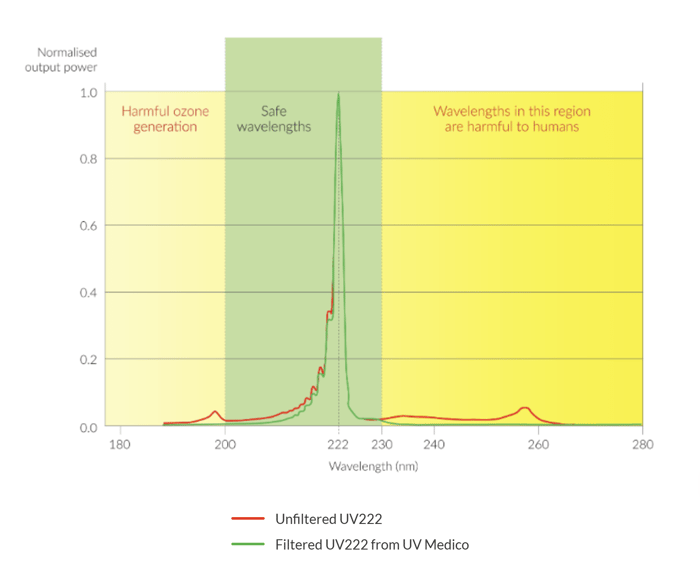
The krypton-chloride lamps used for Far-UVC emit mainly at 222 nm, but without filtering, they also emit a small amount of longer UV-C wavelengths. These penetrate deeper into skin and eyes and have much lower exposure limits, so they restrict how much light an unfiltered lamp can deliver. UV222™ uses an optical filter that concentrates the output at 222 nm.

The result: under the ACGIH TLV (2022), a filtered UV222™ lamp can deliver roughly 3–5 times more 222 nm light within the same 8-hour exposure limit than an unfiltered lamp.
Maximum 8-hour dose (ACGIH TLV 2022) UV222™ (filtered) Unfiltered lamp Eyes ~154 mJ/cm² ~42.5 mJ/cm² Skin ~460 mJ/cm² ~99.5 mJ/cm² In the EU, the ICNIRP-based limit applies (see “What are the exposure limits for 222 nm Far-UVC?” above).
-
What does the research say about human exposure?
Far-UVC at 222 nm has been studied for more than 20 years. More than 100 peer-reviewed studies have been published, and approximately half of them focus on safety.
What the safety studies have actually tested (a few examples from these many studies):
- Long-term chronic exposure (66 weeks): Cancer-prone hairless mice exposed 8 h/day, 5 days a week, at up to 400 mJ/cm², above the ICNIRP limit. No skin cancer, precancerous lesions or excess mortality. (Welch et al. 2022)
- All skin tones: Live human skin from donors of differing age, sex and ethnicity (Fitzpatrick I–VI) dosed at 100 and 500 mJ/cm². No significant DNA damage at 100 mJ/cm² and minimal at 500 mJ/cm², consistent across all skin tones. (Buonanno et al. 2025)
- Extreme human over-exposure (nearly 800× the limit): A volunteer exposed his forearms to up to 18,000 mJ/cm², nearly 800 times the ICNIRP limit of 23 mJ/cm². No erythema at any dose; at 6,000 mJ/cm² a faint surface yellowing appeared and resolved within 24 hours. (Eadie et al. 2021)
- Photosensitive and broken skin: Patients with photosensitivity disorders dosed to the ICNIRP daily limit, plus open pressure ulcers and surgical sites. No erythema, no irritation and no delayed healing. (Christou 2025; Goh 2021; Fukui 2022)
- Eyes in real settings (36 months): Ophthalmologists working under filtered 222 nm lamps for three years, plus 37 office participants at 50 mJ/cm². No photokeratitis, cataract or irritation; the corneal damage threshold was more than 150× the limit. (Sugihara 2024; Kousha 2023; Kaidzu 2021)
Together, the studies show low to no risk for eyes and skin at exposures within the maximum exposure limits. As with any UV source, exposure must stay within the applicable limit, which is why every installation includes an exposure assessment.
.png)
.png)

.png)
.png)


.png)