A patient room is rarely truly empty. Even between rounds, there are clinicians moving in and out, patients receiving care, visitors touching surfaces, and air changing with every door opening. That is why patient room disinfection lighting has become a serious topic for healthcare estates, infection prevention teams, and technical buyers looking beyond manual cleaning alone. In practice, the more useful question is not whether light-based decontamination has a role, but which technology can support continuous contamination control without compromising patient care.
Why patient room disinfection lighting needs a new approach
Traditional room decontamination methods have a clear limitation in occupied healthcare spaces. Many technologies are effective only when the room is vacant, which immediately creates an operational constraint. In a live ward, side room, or high-turnover clinical area, empty-room cycles can be difficult to schedule and even harder to scale.
That matters because microbial risk in patient rooms is not confined to terminal cleaning. Contamination is dynamic. It is introduced and redistributed through staff movement, patient activity, equipment handling, textiles, and airflow patterns. A strategy built only around intermittent intervention leaves long periods in which airborne and surface contamination can re-accumulate.
Far-UVC changes that conversation. At 222 nm, Far-UVC systems are being adopted as a people-compatible decontamination method designed for continuous use in occupied settings, subject to correct system design and compliance with exposure requirements. For hospital decision-makers, that shifts lighting from a periodic treatment tool to part of the room’s everyday infection prevention infrastructure.
What Far-UVC means in patient room decontamination lighting
When evaluating patient room decontamination lighting, it helps to separate conventional germicidal technologies from Far-UVC. The difference is not just wavelength. It is the operating model.
Conventional upper-room or vacancy-based systems may still have a place in some healthcare environments, especially where unoccupied treatment cycles are acceptable. But patient rooms are not laboratories. They are active care environments where access, comfort, safety, and continuity matter as much as microbial reduction.
Far-UVC is relevant because it is engineered for integration into occupied workflows. That makes it suitable for spaces where the goal is ongoing reduction of microbial burden in the air and on exposed surfaces, rather than episodic treatment after the fact. In practical terms, this supports a layered infection prevention strategy that works while care is happening, not only before or after.
For facilities and procurement teams, this is an important distinction. A technology that requires isolation of the room can add friction to bed management and nursing operations. A technology designed for continuous operation can support decontamination without introducing another scheduling problem.
The operational case for continuous decontamination
In healthcare, the best technology is usually the one that staff do not have to stop and think about. Manual cleaning remains essential, but it depends on timing, compliance, product selection, contact time, and human consistency. Patient room decontamination lighting addresses a different part of the risk profile by providing a background layer of control that is always present.
This is especially relevant in rooms with vulnerable patients, frequent clinician contact, and repeated use of mobile devices or bedside equipment. Airborne particles do not wait for the next cleaning round, and neither does environmental contamination. Continuous Far-UVC decontamination can help reduce this gap by operating throughout the day and night, including periods of normal occupancy.
There is also a financial and operational logic. Healthcare-associated infections, delayed bed turnover, and outbreak response all create avoidable pressure on capacity and cost. While no single intervention eliminates risk, decontamination systems that work continuously can strengthen the overall infection prevention model without reducing room availability.
Where patient room decontamination lighting fits in the care pathway
Patient rooms are not all the same. A medical ward bay, an isolation room, a recovery room, and a private inpatient room each present different exposure patterns, occupancy profiles, and ceiling constraints. The right solution depends on room geometry, air movement, patient positioning, care intensity, and the interaction between airborne and surface contamination.
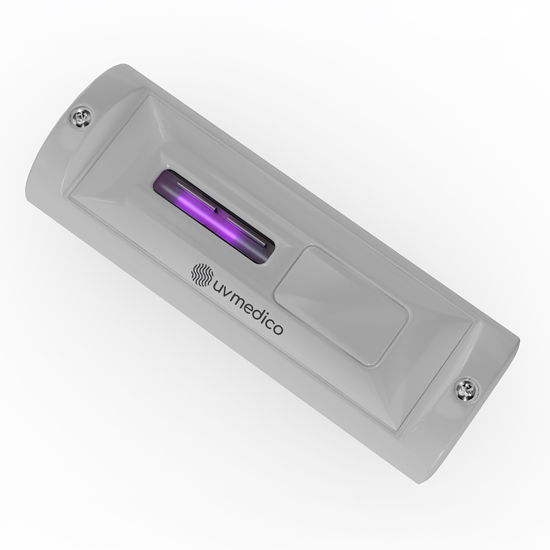
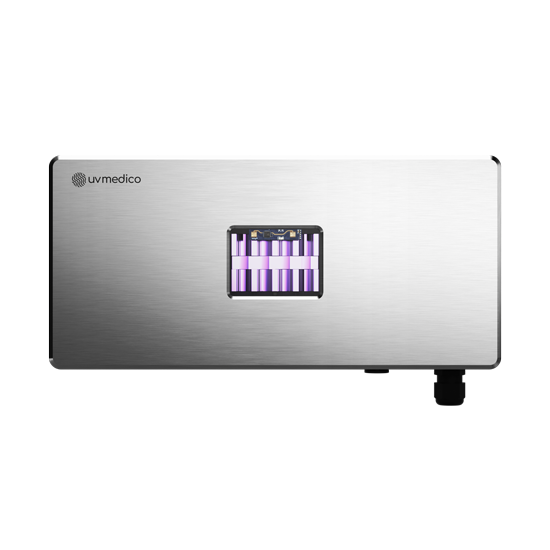
This is where application-specific design matters. Integrated fixtures, downlights, pendants, or linear formats need to be selected based on how the room is actually used. A fitting that performs well in one setting may create blind spots or poor coverage in another. The objective is not simply to install a lamp. It is to create effective decontamination coverage that aligns with exposure limits, room usage, and cleaning protocols.
For procurement and estates teams, this means patient room decontamination lighting should be assessed as part of the wider built environment. Ceiling height, mounting position, maintenance access, electrical integration, and compatibility with existing luminaires all affect the final result. In other words, efficacy on paper is not enough. Installed performance matters.
Safety, compliance, and why specification matters
In occupied healthcare environments, safety claims must be precise. That is particularly true for technologies used near patients, staff, and visitors for extended periods. Far-UVC systems should therefore be evaluated through the lens of compliance, dosimetry, product engineering, and installation design, not marketing language.
A credible specification process considers exposure guidance, fixture output, room reflectivity, occupancy duration, and the required decontamination objective. It also considers whether the supplier can support validation, documentation, and implementation in regulated settings. Those are not peripheral issues. They are central to adoption in hospitals where governance, clinical assurance, and technical accountability are non-negotiable.
This is one reason category-specialist suppliers are increasingly preferred over general-purpose lighting vendors entering the decontamination space. In patient rooms, the margin for error is small. Decision-makers need systems developed for healthcare realities, backed by scientific substantiation and designed for integration rather than retrofit compromise.
Trade-offs buyers should consider
There is no single specification that suits every room. If a hospital is comparing patient room decontamination lighting options, the key trade-offs are usually between occupancy compatibility, decontamination continuity, installation complexity, and validation requirements.
A vacancy-only solution may offer a defined cycle but can be awkward in high-throughput clinical areas. A continuous Far-UVC system can support everyday microbial control, but it requires careful planning to ensure proper placement and exposure management. Likewise, a lower-cost product may appear attractive initially, yet create long-term issues if it lacks the evidence base, support documentation, or application engineering needed for healthcare procurement.
It also depends on the intended outcome. If the priority is terminal room treatment after discharge, one type of system may fit. If the priority is continuous contamination control during occupancy, the specification will be different. Many hospitals will ultimately need both routine cleaning and environmental decontamination technologies working in parallel, each used where it adds the most value.
What good implementation looks like
The strongest projects begin with the environment, not the product catalogue. Patient room decontamination lighting should be mapped to patient flow, cleaning practice, ventilation behaviour, and the infection prevention priorities of the unit. That often means collaboration between estates, infection prevention, clinical leadership, and procurement from the earliest stage.
Pilot deployment can be useful, especially where organisations want operational feedback before wider roll-out. The goal is not simply to demonstrate that a fixture turns on. It is to confirm that the system integrates cleanly into care delivery, maintenance routines, and compliance documentation while supporting measurable decontamination performance.
This is where Far-UVC suppliers with healthcare-specific expertise can make a material difference. UV Medico, for example, positions Far-UVC as a continuous decontamination method built for real operating environments, not a theoretical add-on to cleaning. That distinction matters when buyers are assessing long-term reliability, application fit, and confidence in regulated deployment.
The next standard for patient rooms
Patient room decontamination lighting is moving from niche interest to practical infrastructure because hospitals are under pressure to reduce microbial risk without slowing care. The technologies worth serious consideration are those that match how patient rooms actually function - occupied, unpredictable, and always in use.
Far-UVC is compelling because it addresses that operational reality directly. Rather than asking staff to create empty-room windows for decontamination, it supports continuous contamination control in the background of everyday care. For healthcare leaders balancing infection prevention, compliance, and bed availability, that is not a minor improvement. It is a different model.
The most effective patient rooms will not rely on any single intervention. They will combine disciplined cleaning, sound ventilation, and well-specified Far-UVC decontamination in a framework designed around both safety and uptime. That is where the real value sits - not in replacing existing protocols, but in closing the gap between scheduled hygiene activity and the constant reality of microbial exposure.
.png)
.png)

.png)
.png)


.png)


 Insights
 Science
 Compliance
 Cecilie Aaberg Meltofte : 19 Dec, 2024




.jpg)
.jpg)
.jpg)