.png)
.png)

.png)
.png)


.png)


 Insights
 Science
 Compliance
Reflecting on the Role of 222 nm Far-UVC in Combating COVID-19
 Cecilie Aaberg Meltofte : 19 Dec, 2024
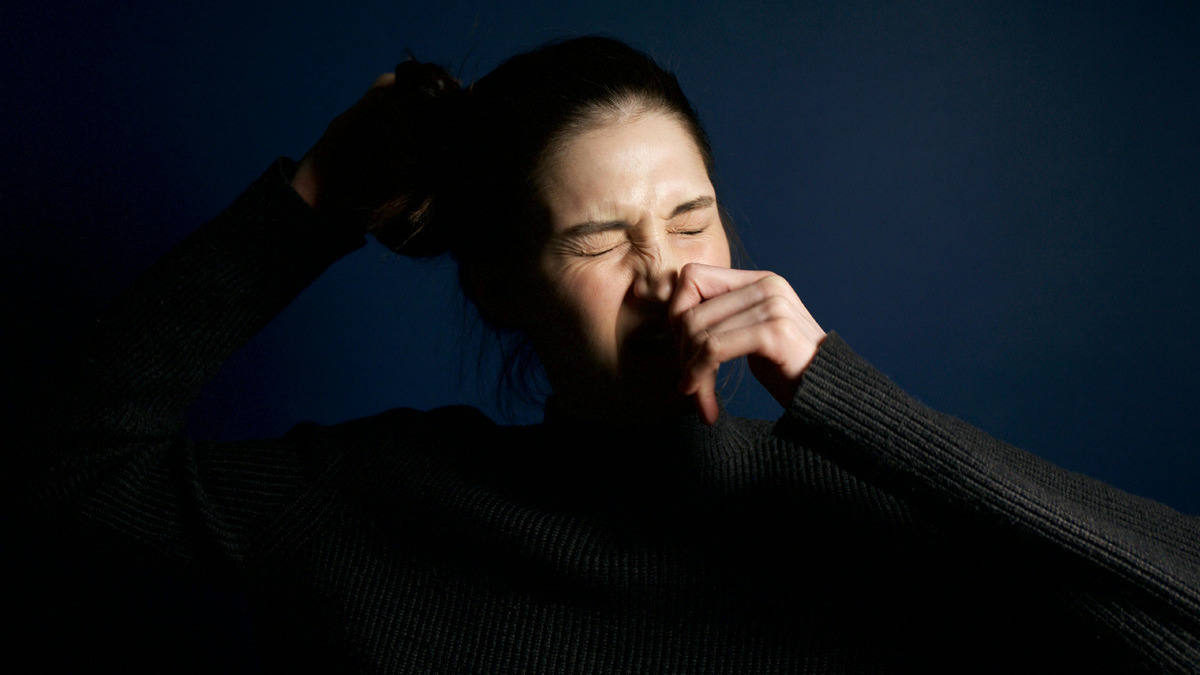
Chances are that you either suffer from allergies yourself or know someone who does. Millions of people worldwide are affected by allergic diseases, making allergies one of the most common chronic health challenges today. In mild cases, allergies may cause sneezing, coughing, or itchy eyes. In more severe situations, they can lead to difficulty breathing, asthma attacks, or even life-threatening reactions.
Traditional approaches to allergen control often rely on regular cleaning and allergen avoidance. While these measures are important, allergens are continuously released into the environments around us through pollen, dust mites, pets, and mold. As a result, allergen levels can quickly return even after thorough cleaning.
This raises an important question: should we rethink how we manage allergens indoors? Instead of relying solely on periodic removal, new technologies may allow for a more continuous approach, one that actively disrupts airborne allergens directly within occupied environments.
A recent study investigated whether Far-UVC light could reduce the immune system’s ability to recognize airborne allergens. The idea is surprisingly simple: if the molecular structure of an allergen changes, the immune system may no longer recognize it in the same way.
To understand why this is interesting, we first need to understand what allergens actually are.
When most people think about allergens, they think about pollen, dust, pet dander, or mold. But at the molecular level, many allergens are actually proteins: highly organized biological molecules with specific three-dimensional shapes.
These shapes are important because the immune system recognizes allergens based on their structure. In allergic individuals, antibodies in the immune system bind to specific regions on the allergen protein, somewhat like a key fitting into a lock. When this binding occurs, it can trigger a chain reaction in the immune system that leads to symptoms such as sneezing, coughing, itchy eyes, asthma, or in severe cases, difficulty breathing.
This is where Far-UVC becomes particularly interesting.
Far-UVC is widely known for its ability to inactivate microorganisms by damaging their DNA and RNA. However, proteins also strongly absorb Far-UVC light. When exposed to 222 nm light, proteins can undergo structural changes through processes such as photooxidation and disruption of their molecular structure and folding.
In simpler terms: the “key” changes shape and no longer fits the “lock” as effectively.
Researchers therefore wanted to investigate whether Far-UVC could reduce the immune recognition of airborne allergens by altering the structure of the allergen proteins themselves.
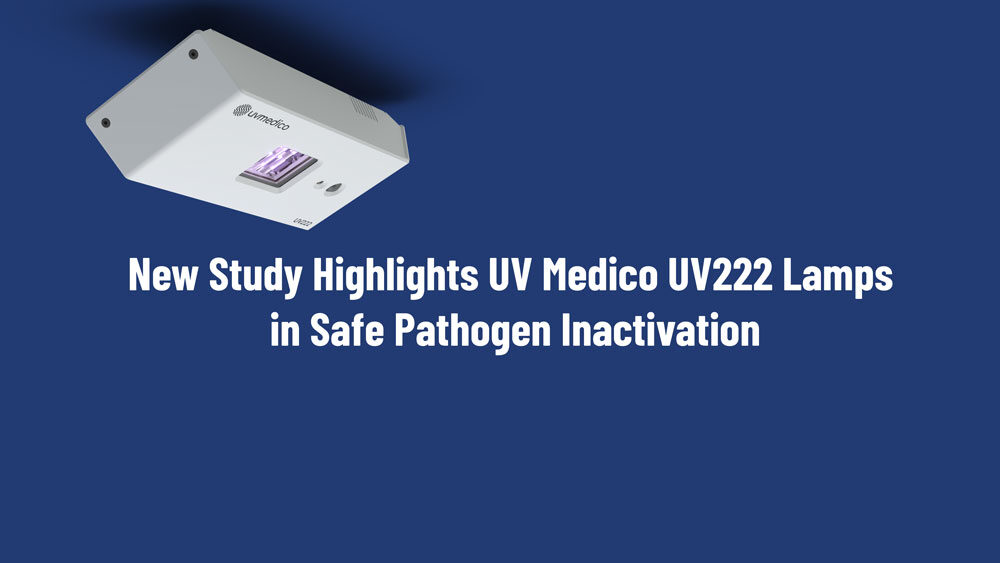
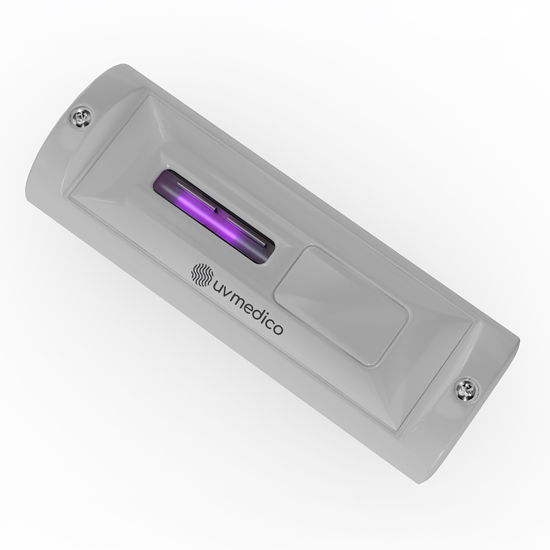
To investigate this question, researchers designed a controlled chamber study using four ceiling-mounted Far-UVC lamps emitting 222 nm light. Inside the chamber, they introduced airborne allergens — also known as aeroallergens — including allergens from dust mites, pets, mold, and pollen.
The goal was to determine whether exposure to Far-UVC would alter the allergens in a way that reduced immune recognition.
Over the course of the experiment, air samples were continuously collected and analyzed using a technique called an immunoassay. In simple terms, an immunoassay is a laboratory method that uses antibodies to detect specific proteins. It works much like the immune system itself: if the antibody can still recognize and bind to the allergen, the allergen is detected. If the protein structure has changed, this binding becomes weaker or may no longer occur at all.
This made the immunoassay particularly relevant for the study, because it allowed the researchers to measure not only whether allergens were still present in the air, but also whether their molecular structure remained recognizable to antibodies.
The study found that exposure to Far-UVC significantly reduced the immune-based detection of multiple airborne allergens, including allergens from dust mites, cat dander, dog dander, mold, and pollen. Importantly, these reductions occurred within time frames relevant to real indoor environments. After 30 minutes of Far-UVC exposure, the researchers observed average reductions of approximately 20–25% in detectable airborne allergens.
The graph below shows the average reduction in detectable dustborne airborne allergens during continuous Far-UVC exposure. This is particularly important because allergens in real indoor environments are rarely present as isolated purified proteins. Instead, they are typically attached to dust particles and other organic material suspended in the air. By studying dustborne allergens, the researchers therefore created conditions that more closely resemble real-world airborne allergen exposure.
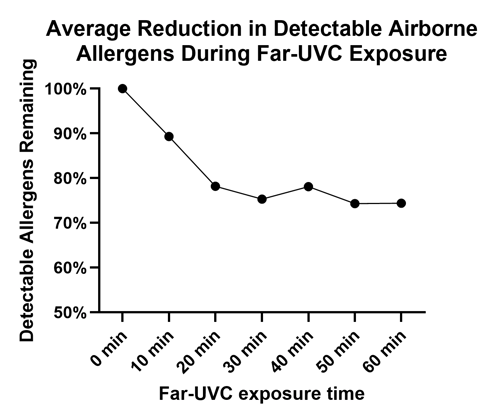
Graph adapted from Eiden et al. (2025), which investigated how exposure to 222 nm Far-UVC affected immune recognition of airborne allergen proteins.
The results demonstrate that Far-UVC exposure altered the structure of the allergen proteins sufficiently to interfere with antibody recognition. In other words, the allergens were still physically present in the air, but their molecular “shape” had changed enough that antibodies could no longer recognize them as effectively.
While more research is still needed to understand the full clinical implications of allergen modification by Far-UVC, the findings highlight an important shift in how we may think about indoor environmental control. Traditionally, UV technologies have primarily been associated with microbial disinfection. However, studies like this suggest that Far-UVC may also interact directly with other biological particles in the air — including allergens.
At UV Medico, this is particularly interesting because it expands the perspective of what continuous environmental intervention can mean in occupied indoor spaces. By integrating Far-UVC technology into everyday environments, the goal is not only to reduce airborne microorganisms, but potentially also to contribute to lowering exposure to structurally intact airborne allergens.
As research into Far-UVC continues to evolve, so does our understanding of how light can interact with complex biological molecules. UV Medico is proud to be among the global leaders in developing Far-UVC solutions for real-world applications, helping bring emerging science into practical technologies for healthier indoor environments.
If you are interested in learning more about Far-UVC technology and its potential applications, feel free to contact the UV Medico team.
Reference:
Eidem, T. M., Rugh, K. M., & Hernandez, M. T. (2025). Far UV exposure (UV222) decreases immune-based recognition of common airborne allergens. ACS ES&T Air, 2(8), 1892–1903. https://doi.org/10.1021/acsestair.5c00080
.jpg)