Far-UVC science and evidence

Filtered 222 nm far-UVC inactivates bacteria, viruses and fungi, while being absorbed in the outermost layers of skin and eye.[1],[2],[3] This is the peer-reviewed evidence behind continuous use in occupied rooms.

170+studies
20+years of research

See all publications See where it's used

Author: , PhD of Molecular Biology

Efficacy

Filtered Far-UVC (222 nm) inactivates a wide spectrum of susceptible microorganisms in air and on exposed surfaces under defined exposure conditions.

  • Effective against a broad range of bacteria, fungi, and viruses, including antibiotic-resistant and clinically relevant pathogens such as MRSA and Candida auris.[1],[4],[5]
  • Effective for both surface and airborne disinfection.[4],[6]
  • Compared to 254 nm UV-C, Far-UVC provides comparable or improved efficacy, including against UV-resistant organisms.[7],[8]

99.8%

reduction in airborne infectious virus (murine norovirus) in an occupied room, with ceiling-mounted fixtures operating within current exposure limits.

Buonanno et al., 2024 [9]

77%

reduction in contamination on mobile workstations in a medical ward, compared to a control ward without Far-UVC.

Mogensen et al., 2025 [10]

Mold growth on plates with and without UV222, day 1 to day 7. Source: Mogensen, E. H. & Holm, C. K. Intermittent low-dose Far-UVC irradiation inhibits growth of common mold below threshold limit value. PLoS One 19, e0299421 (2024).

Emilie Hage Mogensen, PhD, UV MedicoEmilie Hage MogensenPhD, Molecular Biology

Research from UV Medico

At UV Medico, our scientists and engineers are driven by one question: does far-UVC make a real difference where people live and work? That question takes us out of the lab and into the real world.

Mold. Low doses of far-UVC, kept below the exposure limit, held back the growth of common mold. PLOS ONE, 2024

Long-term care. In 12 care homes in Vejle, Denmark, homes with far-UVC showed signs of fewer hospital-treated infections and fewer antibiotic prescriptions among residents. Early results, to be confirmed in a randomised trial. ASHE, 2026
Read more about Emilie Hage Mogensen's research →

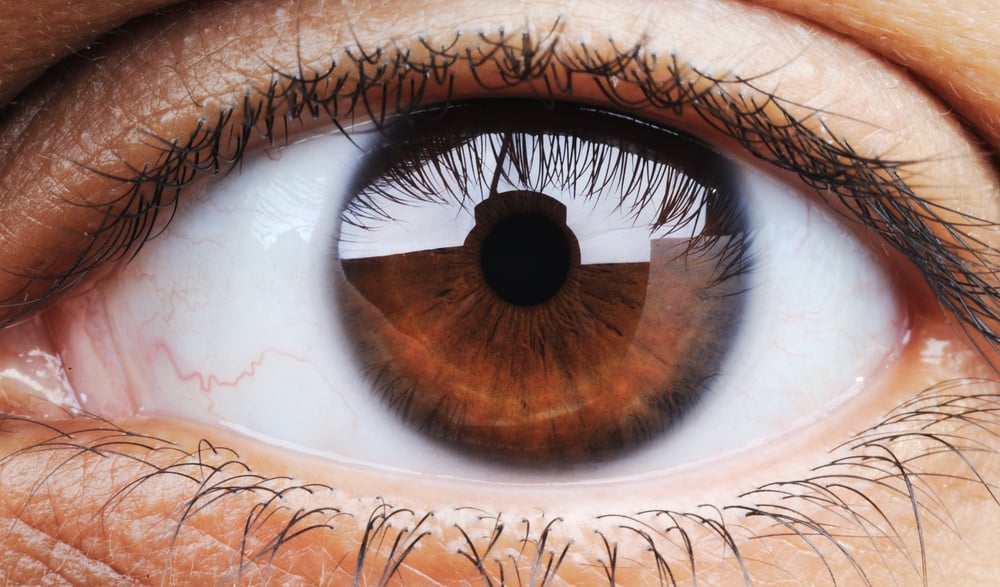
Close-up of a human eye

Safety

At 222 nm the light is absorbed in the non-living outer layer of the skin and in the outermost layer of the cornea, so very little reaches the living cells beneath.[2],[3],[11] This is what makes continuous operation in occupied spaces possible. Exposure limits still apply.

  • Long-term studies in mice found no evidence of skin damage or carcinogenic effects, even at high exposure levels.[12],[13]
  • In patients with photosensitivity disorders, exposure up to 23 mJ/cm² caused no abnormal skin reactions.[14],[15]
  • Clinical and real-world studies reported no eye damage or eye irritation at exposures within established limits.[16],[17]

36 months

of clinical observation of ophthalmologists working under filtered 222 nm lamps: no clinically significant changes in any measured ocular parameter.

Sugihara et al., 2024 [16]

66 weeks

of chronic exposure in a mouse model susceptible to UV-induced skin cancer: no evidence of skin cancer, precancerous lesions, or abnormal skin growths.

Welch et al., 2022 [12]

Certified for a regulated industry

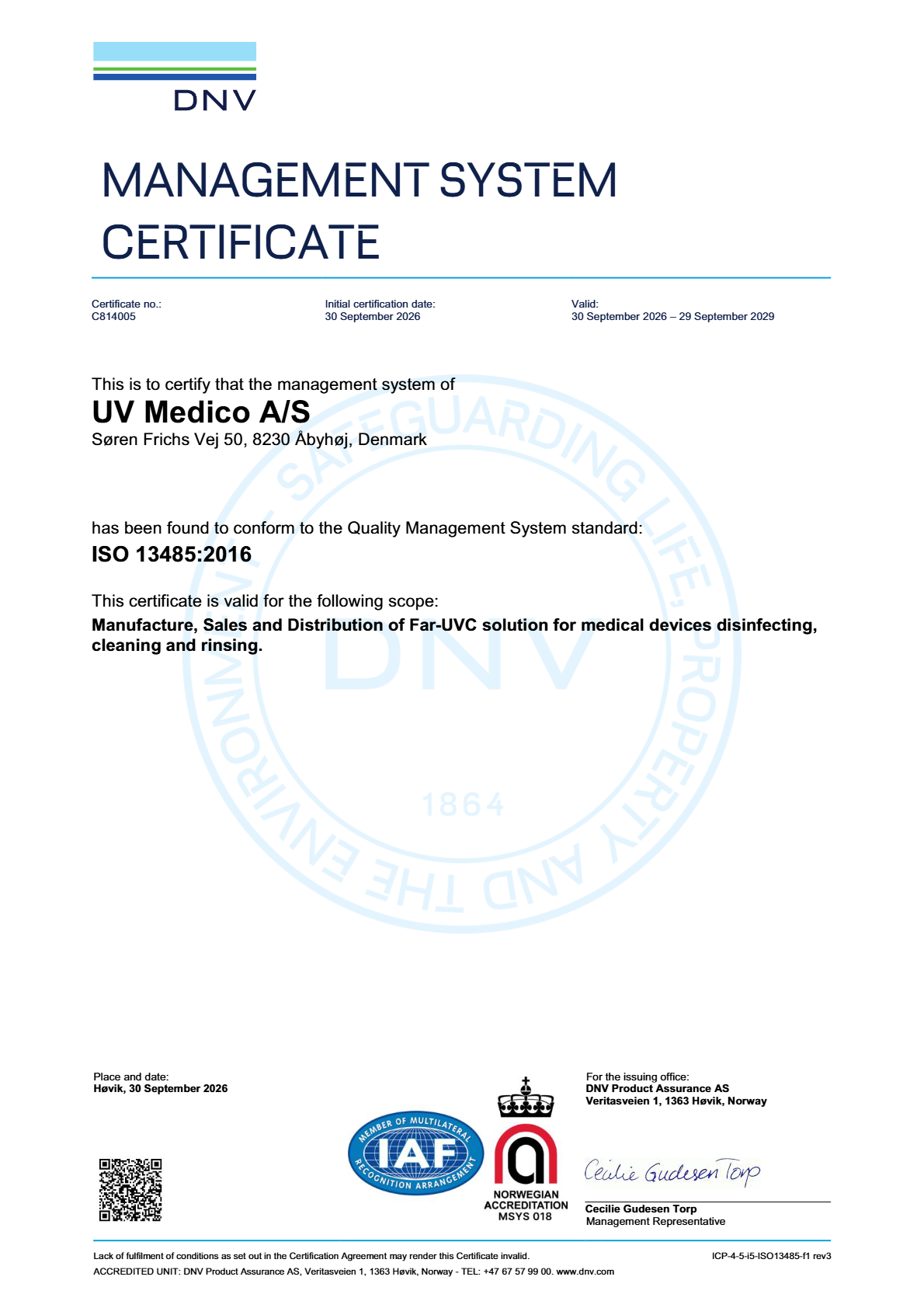
Germicidal UV is governed by photobiological safety standards and occupational exposure limits, and in healthcare and cleanrooms by medical-device and GMP quality requirements. UV Medico A/S develops and manufactures UV222 under three certified ISO management systems, with documented control from design to installation.

Every product is CE marked and tested to IEC 62471. Every installation is designed with an installation-specific exposure assessment against the EU limit of 23 mJ/cm² per 8 hours (Directive 2006/25/EC).

See what far-UVC can do in your space

UV Medico's simulation program models efficacy and safety together — geometry, surfaces, occupancy and how the space is used — rather than an idealised box. Every UV222 installation is designed with an installation-specific exposure assessment.

Request a simulation Get a quote

Prefer to talk first? Contact a specialist →

Frequently asked questions

What is far-UVC?

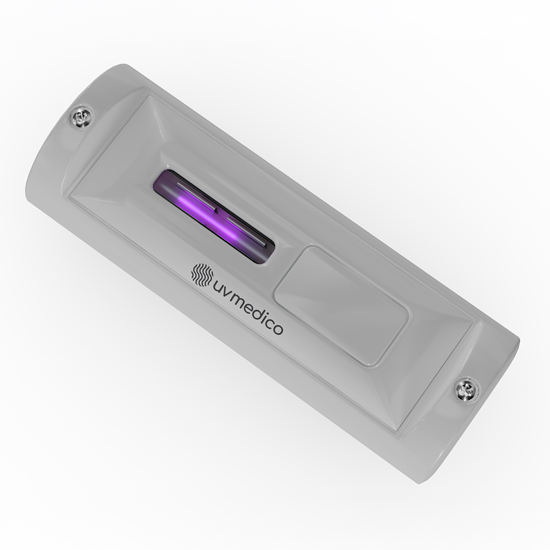
Far-UVC is the 200–230 nm part of the germicidal UV-C band (100–280 nm). UV222 operates at 222 nm. UV222 uses a mercury-free krypton-chloride (KrCl) excimer lamp. Its main emission is at 222 nm, but an unfiltered lamp also emits weaker radiation at longer UV wavelengths that penetrate deeper into skin and eyes. An optical band-pass filter transmits the 222 nm peak and blocks emissions below ~200 nm and above ~230 nm, so the output stays within the far-UVC band. The filter is integral to every UV222 fixture and is not user-removable or optional.

How is far-UVC different from conventional UV-C?

Unlike conventional germicidal UV radiation at 254 nm, which can penetrate living tissues and therefore must be used in unoccupied spaces, Far-UVC light (around 222 nm) has very limited penetration in human tissue. A recent meta-analysis showed that 222 nm Far-UVC provides comparable, and in many cases superior, antimicrobial efficacy to 254 nm UV-C.[7]

Can far-UVC be used when people are present?

At 222 nm the light is absorbed in the non-living outer layer of the skin and in the outermost layer of the cornea, so very little reaches the living cells beneath.[2],[3] This is what makes continuous operation in occupied spaces possible. The integral optical filter and the built-in safety control in UV222 systems are designed to keep exposure within the applicable limit.

Where does the evidence come from?

From peer-reviewed research, laboratory studies and clinical investigations by research groups around the world. Browse 170+ publications in the far-UVC research library.

How does UV Medico apply this research?

UV Medico develops and manufactures UV222 systems with an integral 222 nm optical filter, and co-authors peer-reviewed far-UVC studies. Every installation is designed with an installation-specific exposure assessment. See how UV222 is used in cleanrooms, healthcare, ambulances and shared indoor spaces, or browse all UV222 products.

References

  1. Narita, K. et al. 222-nm UVC inactivates a wide spectrum of microbial pathogens. J Hosp Infect (2020). doi:10.1016/j.jhin.2020.03.030
  2. Finlayson, L. et al. Depth penetration of light into skin as a function of wavelength from 200 to 1000 nm. Photochem Photobiol 98, 974–981 (2022). doi:10.1111/php.13550
  3. Kaidzu, S. et al. Re-evaluation of rat corneal damage by short-wavelength UV revealed extremely less hazardous property of Far-UV-C. Photochem Photobiol 97, 505–516 (2021). doi:10.1111/php.13419
  4. Huang, J. R. et al. Far-UVC light (222 nm) efficiently inactivates clinically significant antibiotic-resistant bacteria on diverse material surfaces. Microbiol Spectr 12, e0425123 (2024). doi:10.1128/spectrum.04251-23
  5. Memic, S., Kaple, C. E., Cadnum, J. L. & Donskey, C. J. Evaluation of an automated wall-mounted far ultraviolet-C light technology for continuous or intermittent decontamination of Candida auris on surfaces. Pathog Immun 9, 156–167 (2024). doi:10.20411/pai.v9i1.683
  6. Eadie, E. et al. Far-UVC (222 nm) efficiently inactivates an airborne pathogen in a room-sized chamber. Sci Rep 12, 4373 (2022). doi:10.1038/s41598-022-08462-z
  7. Liu, Q. et al. Disinfection efficacy and safety of 222-nm ultraviolet C compared with 254-nm ultraviolet C: systematic review and meta-analysis. J Hosp Infect 161, 55–67 (2025). doi:10.1016/j.jhin.2025.04.004
  8. Jing, Z. B. et al. Far-UVC (222 nm) suppresses bacterial UV resistance and repair through inhibition of DNA repair pathways. Environ Sci Technol 60, 1368–1377 (2026). doi:10.1021/acs.est.5c09803
  9. Buonanno, M. et al. 222 nm Far-UVC light markedly reduces the level of infectious airborne virus in an occupied room. Sci Rep 14, 6722 (2024). doi:10.1038/s41598-024-57441-z
  10. Mogensen, E. H. et al. Ceiling-mounted Far-UVC fixtures reduce the surface bioburden in occupied clinical areas. Infect Control Hosp Epidemiol 46, 1–3 (2025). doi:10.1017/ice.2025.62
  11. Buonanno, M. et al. Wavelength-dependent DNA damage induced by single wavelengths of UV-C radiation (215 to 255 nm) in a human cornea model. Sci Rep 15, 252 (2025). doi:10.1038/s41598-024-84196-4
  12. Welch, D. et al. No evidence of induced skin cancer or other skin abnormalities after long-term (66 week) chronic exposure to 222-nm Far-UVC radiation. Photochem Photobiol (2022). doi:10.1111/php.13656
  13. Eadie, E., Barnard, I. M. R., Ibbotson, S. H. & Wood, K. Extreme exposure to filtered Far-UVC: a case study. Photochem Photobiol 97, 527–531 (2021). doi:10.1111/php.13385
  14. Buonanno, M., Petersen, C., Welch, D., Hashmi, R. & Brenner, D. J. 222 nm Far-UVC light and skin health: assessment of DNA damage across different skin types. Photochem Photobiol (2025). doi:10.1111/php.70010
  15. Christou, E., Fenton, L., Dawe, R., Eadie, E. & Ibbotson, S. H. Far-ultraviolet-C exposure in patients with photosensitivity disorders. Br J Dermatol 193, 564–566 (2025). doi:10.1093/bjd/ljaf193
  16. Sugihara, K. et al. Ocular safety of 222-nm far-ultraviolet-c full-room germicidal irradiation: a 36-month clinical observation. Photochem Photobiol (2024). doi:10.1111/php.14052
  17. Kousha, O., O’Mahoney, P., Hammond, R., Wood, K. & Eadie, E. 222 nm Far-UVC from filtered krypton-chloride excimer lamps does not cause eye irritation when deployed in a simulated office environment. Photochem Photobiol 100, 137–145 (2024). doi:10.1111/php.13805