

University of Copenhagen

Case Study · University of Copenhagen

Can far-UVC stop airborne disease in the barn?

Challenge

PRRS — a costly pig virus — spreads through the air, making it hard to contain with cleaning alone.

Approach

A controlled trial at the University of Copenhagen nebulized aerosolized PRRS virus in pig barns, with and without far-UVC.

Result

Far-UVC provided 100% protection against PRRS in the experimental setup.

The Challenge

An airborne virus that’s hard to stop

PRRS (Porcine Reproductive and Respiratory Syndrome) is one of the most economically damaging diseases in pig production.

Because it can transmit through aerosols, surface cleaning and biosecurity protocols alone don’t fully address how it actually spreads — through the air shared by the animals.
The Approach

A controlled aerosol trial

Researchers at the University of Copenhagen designed a controlled experiment to test far-UVC directly against airborne PRRS.

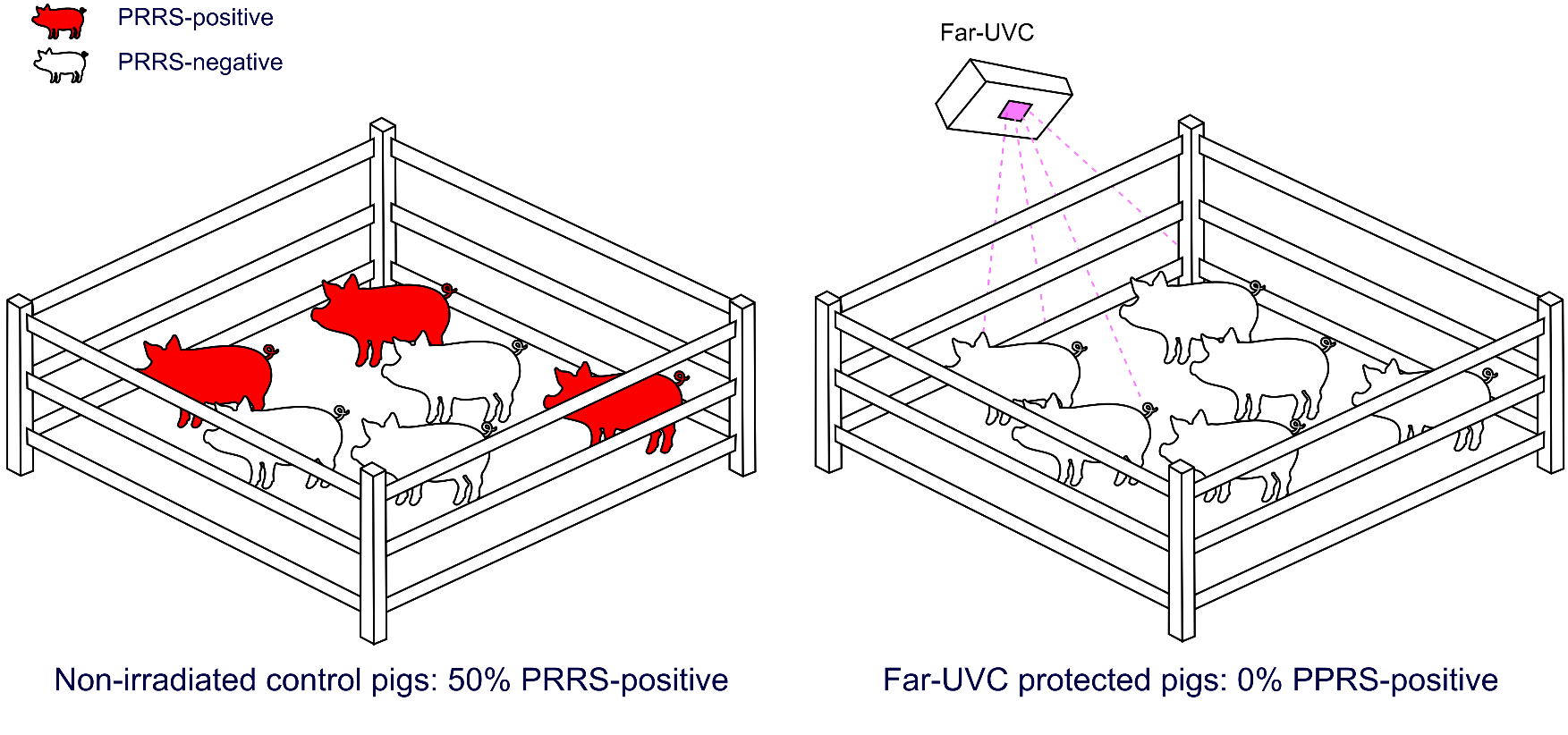
Aerosolized PRRS virus was nebulized in pig barns under two conditions — with and without far-UVC — so the effect of the light on airborne transmission could be measured directly.

PRRS trial: 50% of control pigs infected vs 0% of far-UVC protected pigs
Non-irradiated control pigs: 50% PRRS-positive. Far-UVC protected pigs: 0% PRRS-positive.

The Result

100% protection in the trial

In the experimental setup, far-UVC provided complete protection against PRRS infection.

While control pigs became infected, the far-UVC protected group did not — scientifically demonstrating far-UVC’s ability to interrupt airborne viral transmission.

“Far-UVC provided 100% protection against PRRS in the experimental setup.”

Want the full data?

The trial methodology and results can be linked here.

#">Read the full report

Far-UVC for agriculture?

Talk to our team about far-UVC for animal health and biosecurity. Full references available on request.

Contact Us